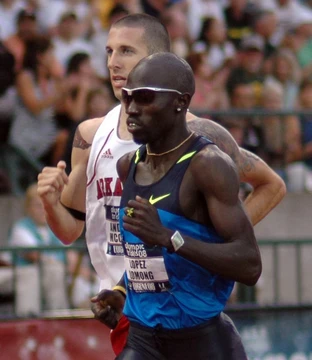
Haile Gebrselassie
Ethiopian long-distance runner and businessman, called the Emperor of Distance Running.

Haile Gebrselassie (born 18 April 1973) is an Ethiopian former long-distance track and road running athlete and businessman. He won two Olympic gold medals and four World Championship titles over the 10,000 metres and won the Berlin Marathon on four consecutive occasions between 2006 and 2009. He also earned four world titles indoors and was the 2001 World Half Marathon Champion. He is considered to be one of the greatest long-distance runners of all time.
- known_for
- Two Olympic gold medals, four World Championship titles in 10,000 m, four consec
Verified Timeline
Lore & Background
Haile Gebrselassie was born one of ten children in Asella, Ethiopia. As a child on a farm, he ran ten kilometres to school each morning and the same distance back each evening, which gave him a distinctive running posture with his left arm crooked as if holding school books. His mother died from cancer when he was six. In 1992, he gained international recognition by winning the 5000-metre and 10,000-metre races at the World Junior Championships in Seoul, South Korea, and a silver medal in the junior race at the World Cross Country Championships in Boston, United States. He won world championships titles in the men's 10,000 metres at the 1993, 1995, 1997, and 1999 World Championships. His 1993 win was infamous as he accidentally stepped on Moses Tanui's shoe at the bell, causing it to fly off; Tanui moved out to a 10-meter lead, only to have Haile run him down on the final straight. In 1995, he set world records in both the 10,000 metres (26:43.53) and 5000 metres (12:44.39). In 1998, he set a 10,000 metres world record of 26:22.75 and a 5000 metres world record of 12:39.36. At the 2000 Sydney Olympics, he became the third man to successfully defend an Olympic 10,000 metres title, winning by 0.09 seconds over Paul Tergat. In 2001, he won the IAAF World Half Marathon Championships and conceptualized the Great Ethiopian Run. He set 27 world records. In 2008, he won the Berlin Marathon with a world record time of 2:03:59, breaking his own world record by 27 seconds; that record stood for three years. His 10,000 m Masters age group world record has remained unchallenged since 2008.
Reader's Guide
Haile Gebrselassie's significance lies in his unprecedented dominance across distances from 1,500 metres to the marathon, his 27 world records, and his role as a symbol of Ethiopian distance running. He won two Olympic gold medals and four World Championship titles in the 10,000 metres, and four consecutive Berlin Marathons. His world record in the 2008 Berlin Marathon (2:03:59) stood for three years. Beyond athletics, he became a successful businessman, contributing to his home country's development. He was cited as one of the top 100 most influential Africans by New African in 2011. His legacy includes inspiring generations of runners and enduring personal challenges, such as the burning of his hotels and resort during the 2020 Hachalu Hundessa riots, which cost 400 employees their jobs, and his 2021 pledge to join the fighting in the Tigray War. He is often nicknamed The Emperor for his achievements.
Did You Know?
- Haile's distinctive running posture, with his left arm crooked, comes from his childhood habit of running to school while holding his books.
- At the 1993 World Championships, he accidentally stepped on Moses Tanui's shoe at the bell, causing it to fly off, yet still won the 10,000 m gold.
- In 1998, he set a 5000 m world record of 12:39.36 in Helsinki despite his pacemakers dropping out six laps from the finish.
- He won the 2008 Berlin Marathon in 2:03:59, breaking his own world record by 27 seconds; the record stood for three years.
- During the 2020 Hachalu Hundessa riots, his hotels and resort were burned, costing 400 employees their jobs.
Career & Achievements
Few athletes in the history of endurance sport have matched the sheer breadth of Haile Gebrselassie's competitive record. Spanning distances from the 1,500 metres all the way to the full marathon, he claimed two Olympic gold medals in the 10,000 metres and four World Championship titles in the same event across 1993, 1995, 1997, and 1999. His indoor résumé is equally formidable, with four world titles and a 2001 World Half Marathon crown. In the latter phase of his career he transitioned to road racing, capturing the Berlin Marathon on four straight occasions from 2006 through 2009. His 2008 Berlin victory, clocked at 2:03:59, shattered his own world record by 27 seconds and held for three years. Across his entire career he registered 27 world records and 61 Ethiopian national records covering everything from 800 metres to the marathon. In 1999 he went undefeated across every race he entered, from 1,500 to 10,000 metres, and in 2000 he again won every race while ranking first globally in both the 5,000 and 10,000 metres. His 10,000-metre Masters age-group world record, set in 2008, still stands untouched.
Defining Moments
Several races in Gebrselassie's career have become legendary for their drama. At the 1993 World Championships, with the bell sounding, he accidentally stepped on the heel of Kenya's Moses Tanui, sending the shoe flying off his foot. Tanui, furious, surged ahead by ten metres, but Gebrselassie chased him down on the final straight to win the 10,000-metre gold. Far more remarkable was his 1998 Helsinki 5,000-metre world record attempt. After his pacemakers dropped away six laps from the finish, even British commentators counted him out. In visible pain, he unleashed a final lap of 56.77 seconds and a closing 1,600 metres in 3:59.36 to post 12:39.36, reclaiming the record from Daniel Komen. The rivalry with Komen played out over several years at Zürich's Weltklasse meet: in 1996 an exhausted, blistered Gebrselassie, fresh from winning the Olympic 10,000 in Atlanta, lost to Komen's blistering 58-second lap, but in 1997 he reversed the script, covering the final 200 metres in 26.8 seconds to set 12:41.86. Komen answered nine days later in Belgium with 12:39.74. The 2008 Berlin Marathon, where he broke his own world mark by 27 seconds, remains perhaps his most iconic road-racing moment.
Legacy & Impact
Gebrselassie's standing in distance running is matched by very few. Widely nicknamed "The Emperor" for his dominance across the sport, he is routinely cited as one of the greatest long-distance runners in history. His record book speaks to that stature: 27 world records and 61 Ethiopian national records spanning a staggering range from 800 metres to the marathon. He became the third man ever to successfully defend an Olympic 10,000-metre title, a feat that placed him in the company of legends. Even after his competitive prime, his 10,000-metre Masters age-group world record set in 2008 has never been challenged. His influence extended well beyond the track. In 2011, New African magazine named him among the top 100 most influential Africans. As a businessman he has contributed to the development of his home country, building hotels and resorts. His 1995 Zürich 5,000-metre performance was voted "Performance of the Year" by Track & Field News, and his 1998 Helsinki record-breaking run, where he overcame the loss of his pacemakers to post 12:39.36, remains a touchstone for what individual determination can achieve in endurance sport.
Life Beyond the Spotlight
Gebrselassie's story begins far from the track. Born on 18 April 1973 as one of ten children in Asella, Ethiopia, he grew up on a farm where the daily commute to school was a ten-kilometre run each way. That childhood routine left a lasting mark: his left arm still carries a slight crook, as though perpetually clutching school books. His mother died of cancer when he was just six years old. His first taste of international competition came in 1992, when he swept the 5,000 and 10,000 metres at the World Junior Championships in Seoul and added a silver at the World Cross Country Championships in Boston. In 1999 he even starred as himself in the film Endurance, which chronicled his quest for Olympic gold in Atlanta. Yet his life after athletics has been marked by both success and tragedy. He built a business empire of hotels and resorts in Ethiopia, contributing to his country's development. During the 2020 Hachalu Hundessa riots, Oromo mobs targeted non-Oromo properties; his hotels and resort were burned and 400 employees lost their livelihoods. In 2021, amid the Tigray War, he pledged to take up arms against the Tigray People's Liberation Front.
Frequently Asked Questions
Who is Haile Gebrselassie?
Haile Gebrselassie is an Ethiopian long-distance runner and businessman born on 18 April 1973, widely regarded as one of the greatest distance athletes in history. He earned the nickname 'Emperor of Distance Running' for his decades-long dominance in both track and road events.
What are Haile Gebrselassie's major Olympic and World Championship results?
He captured two Olympic gold medals and three World Championship titles in the 10,000 metres, plus one World Championship silver in the same event. That combination of track honours makes him one of the most decorated 10,000-metre runners ever to compete.
How many world records did Haile Gebrselassie hold during his career?
Gebrselassie set 27 world records across a range of distances over the course of his career. That sheer volume of records highlights how consistently he pushed the boundaries of human endurance in long-distance running.
What is Haile Gebrselassie known for in the marathon?
He won the Berlin Marathon four consecutive times from 2006 through 2009, a streak that proved his track talent translated seamlessly to the 42.2-kilometre road distance. That four-year run remains one of the most celebrated marathon achievements of the 21st century.
What did Haile Gebrselassie do after retiring from racing?
After ending his competitive career, he transitioned into the business world while staying visible in the global athletics community. His post-racing work as a businessman keeps his name prominent well beyond his on-track accomplishments.
More in Olympic Track & Field 25-30
Elsewhere in the Olympic Track & Field universe
Spotted an error? Know more?
This is a living reference — every entry is fact-audited, and reader corrections feed straight into our audit queue. Suggest an edit · See this site's audit record